



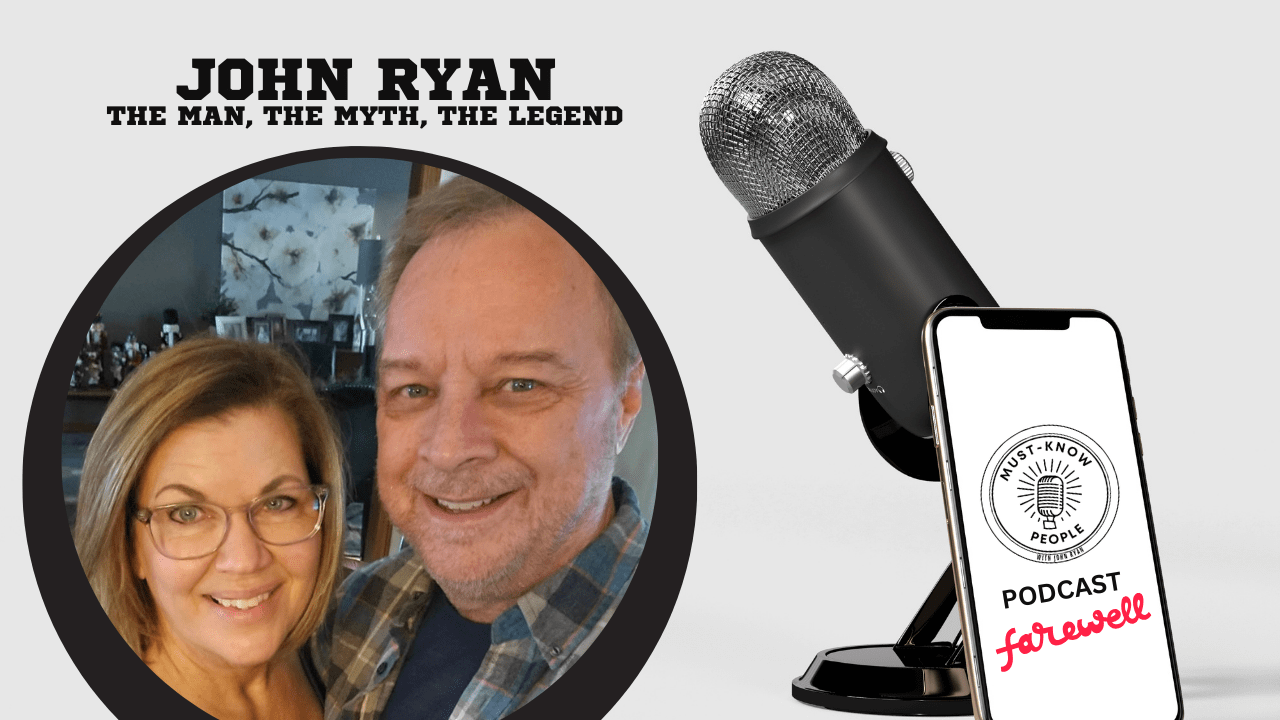
Join us for the last episode of Must Know People, as John Ryan, a legendary voice in community radio, bids farewell to the microphone. Discover the humorous and unexpected turns that characterized John's career, including sleepless nights and memorable mishaps on air. Listen to John's insights on how radio has evolved and what it means for the future as he opens up about his storied past and his plans moving forward.
SPEAKER 01 :
Hey everybody, it's John Ryan. And before we jump into our final episode of Must Know People, I just wanted to take a quick moment to say a big thank you. As the podcast wraps up its second and final season, I started thinking about why it started. The simple idea, a podcast right here that was local to our area that shines a light on people doing great things for our community. What I didn't expect was how much I'd get from it and how incredible people were along the way about it. To all the guests who have joined me over the past two seasons, thank you. Your time, your stories, your passion, your willingness to share, I really appreciate it. You made this podcast what it is. And for everybody who's taken time to listen... Whether you've been there from the first episode or just recently discovered it, thank you to your support and your feedback, your messages. It means more than you possibly could imagine. So every download, every comment, every conversation, it's all kept this thing going. So here's to the past two years. And here's to one more episode of us. No people.
SPEAKER 02 :
Welcome to Must Know People. This show has been about the voices that make the community special. Today's voice is one of those that's been part of the community soundtrack for decades. My guest has been in radio for 37 years, including 31 incredible years at Carroll Broadcasting. He's told thousands of stories, met hundreds of people, and been a familiar friend to listeners across the area. And lucky for me, he happens to be my husband, John Ryan.
SPEAKER 01 :
Yay! Thank you. I told stories that were only approved by you.
SPEAKER 02 :
That is true.
SPEAKER 01 :
A few were not cleared. That is also true. I managed to get away with those.
SPEAKER 02 :
So today we're turning the microphone around for one final episode before he retires.
SPEAKER 01 :
Now, this was an idea that you had. I did. Other people had that said, you should do this, you should do this. And we just never got around to it.
SPEAKER 02 :
Yeah, here we are. All right. So, John, welcome to your show. Thank you.
SPEAKER 01 :
This is so weird. I mean, this is like bizarro world. I've never been on the answering end of questions. Nobody ever wanted to know what I thought.
SPEAKER 02 :
By the way, we are recording this episode with cocktails. So listeners, consider yourself warned.
SPEAKER 01 :
There you go. Got IPA in hand. And there might be a few choice words. I'm sure some stories will come out that I am not going to hold back on exactly what was said, how it was said. Sure.
SPEAKER 02 :
It's your story.
SPEAKER 01 :
This is explicit, people. Here's your warning.
SPEAKER 02 :
This is your story. You get to tell it however you want. I'm just the guide.
SPEAKER 01 :
Let's do it.
SPEAKER 02 :
All right. We're going to talk about the early years.
SPEAKER 01 :
Oh, yeah.
SPEAKER 02 :
Yeah. Let's go back to the beginning. What made you get into radio? Was it fate, destiny, or were you trying to avoid a real job?
SPEAKER 01 :
It's true. I tell everybody on the air all the time. I was like... I get paid to do this. Seriously. I sit in a room and talk to myself. This is what I do for a living. And it's crazy to think that that is actually true, but it is.
SPEAKER 02 :
But how did you get into it?
SPEAKER 01 :
It started, I had this weird fascination with radio and I've told this story on the air, I think before, but I was 10 years old when I knew I wanted to be in radio. I was crazy. Oddly fascinating. We had a radio station in our hometown, KCCR, the most uncool radio station for a kid ever. It was my mom and dad's radio station. Yeah. But I mean, I'm 10 years old. I'm sitting there with my brother, David, his friend Keith and some other friends and stuff. We're sitting on the front porch. of our house and we're bugging the guy on the air. It was just one random night in the summertime. We're like, play this song. It's the cool. Oh, we want to hear this song. And literally at the next song came on, we called him up again and we're like, play this song, play this song. And I'm sure the guy was like, and I got those calls over the years. I'm like, lose the number kid. Just forget it. And yeah. And so we kept bugging him and kept bugging him. And finally he played our song.
SPEAKER 02 :
Yeah.
SPEAKER 01 :
And we thought, yeah, rock star yeah well we thought okay there's our song but to me it was like that guy brought joy to us i thought he is the coolest guy ever i have no idea who he is i've never heard this story yeah and he he played our song it's this dorky little song 1974 billy don't be a hero
SPEAKER 02 :
I mean... First of all, love the song.
SPEAKER 01 :
It's a nerdy little song. It is. That, you know, nobody really clamors to hear anymore.
SPEAKER 02 :
Everybody our age knows all the words.
SPEAKER 01 :
Yeah. She threw the letter away, people. Yep. She threw it away. That's all. Oh, my God. But to me, it was like, this guy... got to talk to everybody. And, you know, and, and back then, if your song came on, that's when you hit record on your boombox. That's how you got recordings of your favorite songs. And I just, I became oddly fascinated with that.
SPEAKER 02 :
Yeah. I've never heard that. That's a great story. Yeah. Yeah. So do you remember your first day on air?
SPEAKER 01 :
Oh, dear God.
SPEAKER 02 :
It was horrid. So I'm guessing you weren't cool and confident.
SPEAKER 01 :
Um, no.
SPEAKER 02 :
Okay. So I got to tell.
SPEAKER 01 :
I went to broadcasting school out in Denver. I was working for the airlines. I mean, I'm 18, 19, 20, 21, early 20s, and I'm working for the airlines. You get flight benefits. I'm like, I think I was meant to do more than read three-letter bag tags. H-O-U, Houston. Yeah, great. That's the most I read during the day. So I'm like, I need to do something else. And so I went to broadcasting school out there. And the only state where I could think to get started because it was so expensive to live in Denver was to go back to my hometown and thought here here, South Dakota. Yeah. And go back to that station that it was my parent's station, KCCR. And I got hired for a whopping $200 a week. Yeah. Cha-ching, baby. I'm on easy street, right? Making bank. Even then, I'm like, are you freaking kidding me? This is all I'm going to make? Right. I thought, oh my God, what have I done to my life?
SPEAKER 02 :
At that point, yes.
SPEAKER 01 :
Do you turn around? Yeah, pretty much. I thought about it.
SPEAKER 02 :
Too late to turn back?
SPEAKER 01 :
I stuck with it. The very first night I was on my own, I was on the 6 p.m. to midnight shift. And the first hour I got to talk like normal people, like a normal announcer. And then from 7 o'clock until 10 o'clock was something called TalkNet with Bruce Williams. I remember that clearly. And during that time, I had to empty the wastebaskets all over the radio station. I had to make coffee. for the GM, the program director the next morning. And then from 10 until midnight, I had to play something called Moonglow.
SPEAKER 02 :
No idea what that is. I'm anxious to hear.
SPEAKER 01 :
I know. I'm like, this should be exciting. It's not going to be exciting because it is literally piano music, elevator music for people to fall asleep to. This is my job. And I'm like, holy crap. So my first night of being on air, I'm just terribly nervous. I'm thinking people are hanging on my every word. Of course, as we all are. Yeah, yeah, exactly. And the only thing I got to do was read sports once an hour. I did like a three or four minute long sports update. And there was a pitcher for the Los Angeles Dodgers. His name was Oral Hershiser. My brothers were Dodgers fans. I knew the name. He was a great pitcher for the Dodgers. I could not pronounce his name correctly at all. Earl Horsheiser. And I'm like, oh, my God, what are you doing? The next hour, I butchered it again. And the third hour, I'm like, I'm going to get this right. And I still butchered it. I woke up the next morning. I seriously did not want to go back. Do you think you were fired? I was horrible. And I remember this. I was living because I was making big bank at $200 a week. I had to live in my parents' basement. Oh, 24 years old, man.
SPEAKER 02 :
So glad we didn't meet back then. I know. I know.
SPEAKER 01 :
Ladies. So, yeah, I remember waking up and hearing my sister talking to my mom. So, well, how was he? And I was like, well, it was pretty rough. And I'm like, oh, my God, that's being generous. I was the worst announcer I think I'd ever heard. But moms, you know, never like, oh, OK. I literally didn't want to go back the next day. But I did.
SPEAKER 02 :
So let's talk about a little bit about the equipment back then, because I've heard you talk a little bit about, you know, how obviously how things change. What was your setup back then?
SPEAKER 01 :
First of all, you could smoke in the studios back then. So it was what they call a fishbowl setup. People could walk by the window and watch you in the studio, which was a little weird. Me being the first time guy self-conscious, you know, you're like, I don't want people watching me and stuff. But the pop filter on the mic, the big padded thing around the microphone, just reeked of cigarettes. And I smoked back then, too. And even I thought it was nasty. But we had a reel-to-reel machine. I had to queue up records, 40 albums and stuff like that, which meant you had to... You had to slowly turn the turntable until you heard that and then turn it back a quarter of a turn and then hope to God you didn't have it on the wrong speed because otherwise it would start off really slow or really fast.
SPEAKER 02 :
So it was actual, it was records.
SPEAKER 01 :
It was records. Like little records. It was mostly albums, but they were all scratched up and beyond belief. So when I came to play Moonglow, it was horrid. But, and then we had a reel to reel machine back there. And one night during moon glow, I hated that so much. I did it for six, maybe six months. that i literally went into the records the recording studio and recorded like a half an hour of stuff just so i could avoid being in the studio for this i hated it and it had these little rubber stoppers on the reels and one night i literally am falling asleep my head is on the counter and i am asleep and somehow in my deep sleep i heard the little rubber stopper go and it fell off And and as I looked back, the reel was falling off of the machine and I lunged for it and it made this huge. It stopped and it finally continued playing. I was like, oh, my God, that was near disaster. Wow. Yeah, it was a disaster. Yeah. Looking back, it was very archaic compared to now.
SPEAKER 02 :
So did you ever think you were going to end up in Iowa?
SPEAKER 01 :
Actually, no, I I got here a very roundabout way. I took a actually a sales job. In Pierce, South Dakota. And I actually knew first five minutes I had the job. I knew I hated it because their their idea of training me was they stuck me in a room with a bunch of VCR tapes from the 1970s that taught me how to be a salesperson. And the guy with the guy with on there was had like the cheesiest 70s mustache. It was just awful. And like I said, five minutes in, I'm like, this sucks. So about three months in, even the general manager knew I was miserable. So he decided he was going to help me get back to what I wanted to do, which was being on the air. So he offered to FedEx my tapes out. And one tape I sent out was to Mankato, Minnesota. It was a rock station, KXLP in Mankato. Got an interview out there. I drove eight hours from pier out to Mankato. And interviewed with a general manager. I interviewed with the program director. I interviewed with the operations manager. I literally interviewed for six hours. Longest interview of my life. And so at the end of the interview, they went, OK, you're our guy. You got the job. I'm like, great. This is my dream job. Rock Station, Mankato, Minnesota, bigger city and all that. I thought I landed great. I had one other interview set up in Storm Lake and I was on my way back driving down I-90 and I hit the 71 exit to go down south. And I thought, I don't need to go there. You know, I got this. Oh, so you weren't going to even go to Storm Lake? I wasn't even going to go. I got this other job. Confidence. Yeah. I got to Storm Lake and the interview was the next day. So I stayed in a hotel overnight and got there. Apparently. From what they told me later on, I was I was cocky and arrogant and all of that. And I'm like, I was in my mid 20s. So I'm like, yeah, that sounds about right, probably for somebody that age. And I thought I didn't need the job. I'm just I'm just there to see the station and do all this other stuff. And so I wasn't really all that interested in it. Well, I drive back home to pier the next day and I get home to my apartment. And then you had answering machines back then, no cell phones. And there was a message on my answering machine. Apparently after I left the Mankato station, they had fired the program director, the operations manager and the general manager. Wow. All of them got canned. Wow. And there was totally new management going on there. And the guy said, we want you to come back out to interview. And I'm like, it's eight hours out there. Okay, fine. I drove back out there eight hours. Well, the new program director said, well, it's no longer a job on the rock station. It's a job on the country station. And he goes, do you live the country lifestyle? You know, you're from South Dakota. And I went, no, not at all. I do not. It was my dream job to be on the rock station. And all of a sudden it changed. Well, he announces that, well, this isn't going to work at all. And got up and left. He left the office, left me sitting there. And I sat there for 10 minutes, at least no word on anything. And I thought, well, hell with it. The interview's over. I got up and I left. I drove back to pier eight hours. And when I got back to pier, there's a message on my answering machine. There was two messages. The first guy was the Mankato guy saying, where the hell did you go? The interview wasn't over. I'm Dude, you got up and walked out. He just left. Yeah. You said this wouldn't work. You left. And nobody came back to explain anything to me. And I was like, I'm done. I'm out. And drove back home. The second message was a job offer from Storm Lake.
SPEAKER 02 :
Oh, gosh.
SPEAKER 01 :
And I took it immediately.
SPEAKER 1 :
It's fate.
SPEAKER 01 :
Yeah. And I was working at K-A-Y-L. I started there. Balloon Days was my first weekend there and Balloon Days was my last weekend there. I worked there 53 weeks and then got the job here in Carroll.
SPEAKER 02 :
So with all the changes in radio now, you've said you've seen a lot. What is the biggest difference that between when you started and today? Obviously, you can say everything, which I suspect it will be you.
SPEAKER 01 :
Well, it's not so much what you can say. You can't really get away with everything like that. But it's it's computers. It's everything. It went from, you know, you had to cover 24 hours a day with live people and you had part timers that were. Either X radio people on the weekend or just God awful people on the air. Oh, and we went through that here.
SPEAKER 02 :
I was going to say, yeah, we've we've heard we've heard them all.
SPEAKER 01 :
Yeah. When I started, there was two stations and 17 people on staff, including part timers. I mean, and now we have like eight staff. Full timers and that's it. So yeah, it's that part of it. The computers were great because they kept your good people on the air and they could do more voice tracking and cover more hours. But yeah, it kind of tucked away for a little bit.
SPEAKER 02 :
So now, but yet people now can do, you can, you can do it from your phone.
SPEAKER 01 :
Yeah.
SPEAKER 02 :
You can run your programs.
SPEAKER 01 :
I can pull up Casey, by the way, people, Casey, I could pull up any of the stations, play whatever I want, whenever I want. I may have told you differently in the past. I just didn't want you to know. True. That we have that much control over this stuff. And it's crazy. It's really, really cool. I have a studio at home now.
SPEAKER 02 :
Yes, let's talk about why we have a studio from home. Let's talk about that.
SPEAKER 01 :
Because I rolled my truck one morning.
SPEAKER 02 :
Yes, you did.
SPEAKER 01 :
I told Chantel Grove, our news director at the time, there's only two reasons to call in sick. You're on your deathbed or you're in the ditch. One of the two. And that's the only time I've ever had to call in because I'm in the ditch.
SPEAKER 02 :
Yeah. And it's 5.05 or 5.10 in the morning and I'm on the treadmill in the morning.
SPEAKER 01 :
Hey, you should feel lucky. You were my first call.
SPEAKER 02 :
Yes. You go in the ditch and you call me to what? Come get you. Yeah. First of all, you've just gone in the ditch and you want me to get in the car and drive to get you.
SPEAKER 01 :
It wasn't horrible. I hit a patch of ice, and that's why I won. But seriously, if you're going to roll your truck, do it into a snow-filled ditch. Because it was like landing in a pillow. But I did have a tool bag in the back with hammers and stuff in it. And that landed on the front seat next to me. I was holding my coffee cup, which you had to hold a button to drink. I was still holding it when the truck came to a stop. I'm like, didn't spill a drop of my coffee. And yet I came to get you. You came to get me. I did. Yeah, well, the guy eventually pulled me out of the ditch and I drove my truck. But you were out there right on that hill between this S curve and Auburn.
SPEAKER 02 :
So it was right after that. We have a studio in our upstairs because I said, it's not worth it.
SPEAKER 01 :
So it totally is not. So and I have used it a couple of times since then. I've used it to voice track other times and stuff like that. But it's come in very handy.
SPEAKER 02 :
So on the changes in radio, are there any technology disasters you want to confess to publicly now that you're ready to retire?
SPEAKER 01 :
I don't know about technology. Yeah. I mean, there's countless times I've been called in the middle of the night because, oh, transmitter's off the air. Guess who it calls? Yeah. And I'm like, okay, no. And you're supposed to punch it all in by codes on the phone. I'm like, oh, my God, what is that code? I mean, it's 2 o'clock in the morning, whatever. The biggest issue with technology is how we screw it up. I mean, there are people it's it's people making mistakes that screw up the technology because that led to one of the one of the more colorful moments in my broadcasting career, because I was after we first got something called.
SPEAKER 02 :
I really hope you're going to tell the story about broadcasting. It's not it's not the football game story. OK, this is you're going to do that next, right?
SPEAKER 01 :
Well, we can. So I am literally like we're hooking this new system up and the guy goes, it's going to be two weeks of pure hell. You're going to wish you never saw this system. But after that, it'll get better and stuff. And it was more like about four weeks of pure hell. And we're about three and a half into it. And I am in the little news studio that we have now. And I'm voice tracking for one of the first times for other stations. Well, in the news studio, you can pull that studio up from the KCIM studio. And so the last person on air, and I remember who they were. I won't mention his name. Please do. No. I so want to call him out for this because this is literally not my fault. They can't fire you.
SPEAKER 02 :
Just remember.
SPEAKER 01 :
I mean, this system had screwed up and screwed up and screwed up. And I frigging lost it. I said every combination of every swear word you can imagine. No. I let loose. And I just had a complete meltdown. Yeah. You've seen me from time to time. I've done that. We've both done that. And I'm partial to some of my swear words and things. And it's going out over the air. No. I'm looking over. I'm like, God, I finally stopped for a second. I look at every phone line is lit up for the radio station. We have three rollover lines, studio lines. They're all lit up because I have gone on a cussing tangent that, I mean... unparalleled i don't think in carol broadcasting history and uh next thing i know chris our old bookkeeper is running in the studio window waving her hands going stop stop stop and then the phone she's like phone phone and i pick it up and it's the guy who left the pot up in that studio which shouldn't have gone out over the air he goes you're going out over the air and i'm like How the hell am I going out over the air? You're going to add to it. Yeah. And I literally, five minutes later, walked over there in the studio and went, by the way, you know, apologies for what you all just heard a few minutes ago. Were you really calm about it? Yeah. So sorry. At that, I'm like, I'm resigned to the fact either I'm going to get fired. So how long ago was this? This was years ago. I mean, this is probably.
SPEAKER 02 :
Well, you've been at Carol Broadcasting for 31 years.
SPEAKER 01 :
Yeah, this is probably the early 2000s, maybe. Something like that. Okay.
SPEAKER 02 :
And hopefully not that many people were listening.
SPEAKER 01 :
Yeah. Or believe me, the ones on the phone lines were listening.
SPEAKER 02 :
Hopefully the kids got a, you know, weren't listening. They didn't get an education.
SPEAKER 01 :
They got it. Oh, everybody got an education that day. I use combinations of words I probably haven't used since. Yeah. And I got on the air and I apologize. I said, by the way, what you heard was not obviously supposed to go out over the air. It was never meant to. It was a technical issue. I blamed it on that. And when Neil Trobeck, the general manager who hired me, came back in from his lunch and I said, OK. I need to talk to you. I said, you're either going to laugh or you're going to fire me. One of the two. And he chuckled and he goes, well, did you learn your lesson? I said, yep, sure did. He goes, okay, enough said.
SPEAKER 02 :
Sweet.
SPEAKER 01 :
That was it. Oh, that's sweet. Yeah. That was one of the very few times Neil and I saw eye to eye. I could tell you about some worst general managers that I worked for. No, no. There's very colorful people in radio. The first general manager I worked for, I kept calling him by one name and everybody else called him by a different name. And it confused me. And I'm like, why do you guys call him this name when his name is this? And they said, well, no, he got married. And because he had filed for bankruptcy so many times, he changed his name to his wife's name. So his name is now this. And I'm like, oh, okay. That clues me in a little bit on this guy. Oh. The second.
SPEAKER 02 :
They weren't calling him a hole.
SPEAKER 01 :
They were calling him some other name. Yeah. Yeah. And it confused me. I didn't know who they were talking about. And the second guy I worked for was just an OCD maniac. He would literally put out memos saying the toilet paper had to come over the top, not under the bottom. And women's skirts had to come. Super fun guy. Yeah. Super fun. Yeah. Yeah. I mean, he literally thought we were the worst radio station in the world because the windowsills in the studios were dirty. Oh, I would love to work for him. Yeah. We had staff meetings. He would talk about this. And I'm like. You're an idiot. What the hell? I worked there for three years, and I don't know how the hell I did that. I was program director for a year and a half there.
SPEAKER 02 :
I think I know which station you're talking about.
SPEAKER 01 :
Okay, WYR, Winter, South Dakota. There you go. There's a street in Carroll that's named, that's his last name. And every time we drive on it, I say his favorite swear words together. Yes. Yes. God damn it. And he had the worst voice. That's all I ever heard from him, and he had terrible voice. Yeah.
SPEAKER 02 :
So we're going to switch it up a little bit. OK, we're going to talk about family. All right. And because radio just wasn't your career, it was definitely part of Kate's childhood.
SPEAKER 01 :
Oh, yeah. She grew up on the.
SPEAKER 02 :
What are some of your favorite memories of having her there with you?
SPEAKER 01 :
Just the holidays. She was always there on like Christmas or something like that. And I've got recordings of her. I know. From the time that she was singing Britney Spears. Oops, I did it again. That's the only thing she knew how to do. Or just make noise, grab the microphone and make noise. She was, she's always been on the air.
SPEAKER 02 :
Yeah. You guys have some good memories though.
SPEAKER 01 :
And she loved it. I mean, I thought she'd be embarrassed by it. I thought, oh God, dad, here we go again. Dad's going to do this to me. And she loved it. She always wanted to be on the air.
SPEAKER 02 :
So did you ever think she was going to follow in your footsteps?
SPEAKER 01 :
I was afraid she was going to follow in my footsteps because she was...
SPEAKER 02 :
Did she witness enough chaos to run the opposite direction?
SPEAKER 01 :
She saw me work a lot of weekends, a lot of nights and everything like that. And she said, nope, I don't want to do that. I don't want to work weekends because I worked weekends every job and holidays, every single job I've ever had since I've been 14 years old. Yeah. When I retire now, it's like, okay, I will never work another weekend, another holiday. I don't have to worry about it.
SPEAKER 02 :
Yeah.
SPEAKER 01 :
That's one of the perks.
SPEAKER 02 :
Yeah, I mean, you and Kate have some special memories. Some songs you played at her wedding, or you guys...
SPEAKER 01 :
Yeah, I've always played her a song on her birthday and things like that. And yeah, the ones I wanted to stick never stuck. But the one I played recently, that's the one that stuck. And we did our first father daughter dance. That's exactly.
SPEAKER 02 :
Yes. I mean, there's a lot of meaningful songs there.
SPEAKER 01 :
And I had some dude at her wedding tell me, well, you know, that song is about a parent growing up. Yeah, I know. Dude, I've been a radio for almost 38 years.
SPEAKER 02 :
Thanks, buddy. Yeah.
SPEAKER 01 :
I don't think you need to explain to me.
SPEAKER 02 :
Thanks, buddy. OK, so 31 years at Carol Broadcasting.
SPEAKER 01 :
Yeah.
SPEAKER 02 :
Let's talk about Carol Broadcasting. Oh, let's. It's not a job, but quite frankly, it's quite a marriage.
SPEAKER 01 :
It literally is.
SPEAKER 02 :
It really is. I mean, longer than we, you and I have been married. Yeah. What kept you there so long?
SPEAKER 01 :
You know, when I first got hired, I interviewed with Neil Trobeck. He was the general manager then. And he told me, he goes, honestly. I've never worked at another radio station. I don't know what it's like. I don't know how they operate. I don't know anything they do. So I want somebody to come in and bring those ideas. I said, well, I'm willing to try things. And I've worked at a couple of different radio stations. But he did say, I'm going to retire in two years, so you probably need to get out of here by then, too. Oh. He told me I should leave at two years because he was going to retire and God knows what's going to happen after that.
SPEAKER 02 :
What year was this? 1994. So he thought it was all going to hell at that point. Pretty much.
SPEAKER 01 :
OK. He did not retire at two years. He and I, like I said, butted heads a lot over the next six or seven or eight years or whatever he was there. But, yeah, he was the one that hired me. And he literally said, your hours are your own. And, you know, you do you program and say you do what you want to do. And I thought that is so unique because in radio, the average lifespan of a disc jockey in a major market is 18 months. They literally get a lot of the times. Yeah. There's so much change and turnover in bigger markets that you don't get long time employees and people on the air. So, I mean, you always hear about these people that are there forever and a day and they're legendary. And so that's the exception. That is not the case. So yeah, And I did, I thought a couple of years, I'm going to move on. I'm going to go to Des Moines. I'm going to move up in markets. I want to do something like that. Cause I had, I was like, you either made it to the major markets or you're a failure. That was my thinking at the time. And honestly, then, then Kate came along.
SPEAKER 02 :
I knew family would come in here.
SPEAKER 01 :
And I thought, I looked around and thought, you know, Carol's a pretty nice place to raise a family. It's, it's a lot like my hometown pier, except I would never move back to pier ever again.
SPEAKER 02 :
Something special about Carroll.
SPEAKER 01 :
Yeah. And it was like, OK, it's a good place to raise a child. And I literally get to do whatever I want to do as the program. And that puts a lot of pressure on you to you've got to come up with all the promotions.
SPEAKER 02 :
I mean, a lot of responsibility.
SPEAKER 01 :
Yeah. The staffing, the hiring, the firing, the everything that goes on was my job.
SPEAKER 02 :
And then from program director, you went to operations manager.
SPEAKER 01 :
I was always the operations manager. So I was always over all three radio stations. Oh, okay. Which meant when I came in, I had to tell the current program directors, you're no longer program director. So I had to basically do that. That sucked. I hated that. But I thought, okay, I could go to Des Moines. I could go somewhere else and start over. but I don't want to do that. I'm in my thirties now. And I'm like, I want to build something kind of special and start doing new things here. And, and I can do that here because I control everything, literally what I want to do. And that never really changed when Kim took over as general manager. I mean, nobody ever really told me you can't do that. Yeah. So what other dream do you have? It was like you get to do whatever you want to do. But the hours were very consuming. That is because you're harder on yourself than anybody else will be.
SPEAKER 02 :
OK, so we're going to go back to a story that I want to hear. And I love when you tell it.
SPEAKER 01 :
What exactly?
SPEAKER 02 :
What's the funniest thing that ever happened on air? And it's funny for me and everybody else. I don't know if it's as funny for you.
SPEAKER 01 :
OK, this is where a lot of the explicit part comes in, because.
SPEAKER 02 :
Well, are you going to say exactly what happened? Uh-huh.
SPEAKER 01 :
OK. So I'm going to backtrack a little bit here. OK. Kevin Munson was the news director and he was also the sports director. And he said, well, what do you think about, you know, maybe covering other sports? And I said, absolutely. Let's do it. Best way into a community is through their schools, through their sports teams. Let's do it. You know, let's go cover some other teams and do things like that. Otherwise, the only thing they ever did was broadcast the home football games or the home basketball. And that was it. So we started doing a lot more games. And I was out covering the Carroll Tigers. And I don't want to say it was Seidel at that time or something like that. And Jim Van Dyke was our color guy. Jim, great guy, did color for us for years on the Carroll Tiger broadcast. Loved working with him. Well, there was this game. Carol's Carol's clearly better than Seidel. And they're just absolutely killing this team. It's 50 to nothing in the second quarter. And this backup quarterback comes in and just gets creamed on the sideline. It knocks him. I'm like, oh, this kid's done. He's probably got a concussion or something, maybe. But so we go on with the broadcast in the third quarter. you know, about midway through here comes the second string quarterback back in the ball game. And I'm like, Hey, you know, this is, this is great. And I meant to say either he took a hard shot or took a hard hit in the second quarter, but it literally came out. Nice to see him back in the ball game after he took that hard shit in the second quarter.
SPEAKER 1 :
Yeah.
SPEAKER 01 :
And Jim Van Dyke was on the floor. He was dying laughing. Who would not be? I know. And I'm like, I just sat there and went, oh, God, I can't believe I just said that. Unbelievable. And he said to you? Oh, and he literally was off the broadcast for like five minutes because he couldn't talk. And I was like, eh, nobody's probably listening. It's 50 to nothing. I would be incapacitated at that point. Not one person called the station to complain. Really? Yeah. So. I still remember that kid's name. And I'm like, I'm sorry. I'm sorry. I didn't mean to tell you that, say that about you.
SPEAKER 02 :
Of course, early on, you had the whole MF, whatever.
SPEAKER 01 :
Yeah, that was well after the cussing tangent. Yes. Yeah. If anybody has any, I don't think anybody's ever swore more on the air than I have. Really? Yeah. You know what? I don't think anybody else has.
SPEAKER 02 :
So that's a good segue to your coworkers. So let's let's talk about Carol Broadcasting. Thirty one years now. That's not a job. That's a marriage.
SPEAKER 01 :
That is.
SPEAKER 02 :
Yeah. What kept you there so long? How did you get there, first of all?
SPEAKER 01 :
I love I love the analogy of the marriage. It's like, man, you run the gamut of everything. You had good days, bad days, everything in between. You know what? My good friend, Joel Schrader, who was my roommate in winter, South Dakota, had a job in Carroll and he recommended me for the job. And I interviewed with Neil Trobeck and. Honestly, you know, once I got there, things were not great the first few years. We had probably two, 300% turnover in the first couple of years. Yikes. Yeah, we went through people left and right because we kept trying to hire people from Brown Institute out of Minneapolis. It's a broadcasting school. And it took us a long time to figure out, well, these kids are going to want to spend a year out at some other station, and then they want to go right back to Minneapolis. Sure. They don't want to stay in small town Iowa. So we struggled with that for a long time. Then we finally... It all changed with one hire, Lance Kuhn. He was from Lake City. He was a local kid from Southern Cal High School and great with computers. And Lance is one of those guys that loves to play around and find out what all they can do. So he was terrific with production and stuff. And he taught me everything. how to do a lot of different difficult production and stuff. So he was great. I mean, from then on, it was like, okay, the second person we kind of hired was just right about the same time. We hired Renie Osterlund temporary to fill in for Drew Hodges who had passed away from cancer. And then Jeff Blankman. Well, Renie's from Lake city, Jeff's from Dow city. We're like, great. I've got three people that are from this area that know that. what this area is all about. They want to be here in the area. And, and from then on for 20 years, we were solid. I mean, Lance was worked his way up into being almost an engineer for the radio station. He did a lot of work with the transmitters and he even helped wire rewire the studios. Oh, wow. Crazy good stuff. And Rainey was terrific on the air. I mean, she was just this personality, this she's always teased her that, you know, she could shut the studio door and I could hear still here down the hallway in my office. Yeah.
SPEAKER 02 :
You may have mentioned that once or twice. She has a voice that carries. Yes, you mentioned that.
SPEAKER 01 :
Yeah, and she was terrific. And Jeff, of course, man, he took a sports department that he was the news and sports guy. He literally at one point was the news director doing news in the morning. He'd cover like city council, school board meetings, had no assistant news director. He would do sports at night, and he worked literally overnight some nights at Hy-Vee stocking shelves. Oh, man. I said, dude, when do you sleep? He goes, oh, I can't sleep. And I was like, you're going to kill somebody out on the roads. We need to divide this up. So eventually we just, you know, we hired a news director and he became sports director. But we never covered wrestling. We never covered track necessarily. If they sent the stuff to us, we would read it on the air occasionally. But Jeff changed all of that. So nobody's going to outwork Jeff. I mean, that guy eats, sleeps, lives, and breathes local sports. You tell me that all the time. Yeah, all the time. And so... That's going to continue on with him. Rini is going to take over my position. Well suited for all of that. I mean, she's got the leadership ability after 20 years. I mean, she kind of knows exactly, you know, what, what it's all about. And so they've got that consistency going forward. So yeah, I think they're, they're great going forward. And, and one of the other people that we hired that was from around the area was Nathan cones. He was actually from Harlan.
SPEAKER 02 :
What? Not from Lake city. Nope. Seems like everybody else is from Lake city. Yeah.
SPEAKER 01 :
Yeah, he was from Harlan and he was actually working at the old Kmart here in Carroll when he heard about the job. So he had no plans of being in radio or anything like that, but started as our assistant news director. And he just kind of, you know, worked his way into this. He's obsessed with news now. He loves doing it. And he's our news director and he does a terrific job with it.
SPEAKER 02 :
He does.
SPEAKER 01 :
You know, anybody can wade through and stay awake through budget processing and things like that, man. Dude, mad props. I heard you talking about that the other day. Yeah. Only Nathan can, even he admits it's boring, but man, you need somebody with that, that can understand it and do all that to, to do that. To be fair, it might be my thing too, but you know, you're the one that's masterminding our finances going forward. So mad props to you as well. Honestly, the Collison family has been great to me. They let me do whatever I wanted pretty much the whole time. If there was promotions I wanted to do or they go, well, what do you want to do? Let's do this. Okay, let's do that. Who gets that kind of control in their job? It's crazy.
SPEAKER 02 :
Well, and you've been in this business for that long, so you know what to do. You know what needs to be done.
SPEAKER 01 :
Probably most of the time. There's a lot of times where you just wing it and go, well, I hope this works. But we tried a whole bunch of different things and thankfully people accepted it and liked it.
SPEAKER 02 :
All right. So retirement and what's next?
SPEAKER 01 :
Yeah.
SPEAKER 02 :
After 37 years, how does it feel to know you won't have to wake up at ridiculous hours to talk about the weather every day?
SPEAKER 01 :
You know, every day I make a list. You do. Every morning I make a list of five things and I tell every announcer, make your list of five things. Yeah, I don't know. I literally don't know what it's going to be like because now that December is here, it's suddenly getting real. Yeah. But I told him back in February that this is it. I'm going to be done. Yep. And so for the whole year, it's been kind of like, oh, yeah, isn't that cute? I'm going to retire in December, blah, blah, blah. Now I'm like, wow. Shit's getting real. It is getting real. And I don't know. So what are you going to be most excited? It's 95% exciting, 5% terrifying. Yeah.
SPEAKER 02 :
Is it?
SPEAKER 01 :
Yeah, I tell people that all the time.
SPEAKER 02 :
Yeah, you know what? I get that. I'm going to be retiring eventually here too.
SPEAKER 01 :
So we are going to be spending a lot of time together. And I'm so sorry for you. I'm going to apologize right now.
SPEAKER 02 :
We will work through that. And now for one last time, is there anything you'd like to say to the community that's listened to you for 31 years?
SPEAKER 01 :
Yeah. Thanks for putting up with me. You know, one of the, I always said my, my air shift is the one thing I will miss completely because that was the four hour. I mean, you do four hours of on air work and then you do the rest of your job. Everybody thinks once you're done on air, you're done completely. No, it's not the way it works, but. After a while, I mean, you just learn to be yourself and to let it all hang out. And people accepted me for that. And I honestly think I'm a better person now because I'm more comfortable in my own skin.
SPEAKER 02 :
Well, and people got to know you. Yeah.
SPEAKER 01 :
Just by talking. Told lots of stories about my family, about you, about everything that goes on. Memories of growing up as a kid.
SPEAKER 02 :
Yeah. Oh, yeah. And yeah, coming from Pierre and your teacher. And I mean, yeah, there's a lot of stories there.
SPEAKER 01 :
Yeah. And I posted in the studio. I said, people don't listen to the radio for music. They don't listen for anything else. They want companionship. So... Hope I provided that for people and hope that they had fun listening. I hope they had a smile on their face. Just lightened up their day a little bit because you can take everything too seriously. Radio shouldn't. I always tell you, it's not life or death. It's radio, man. That's it.
SPEAKER 02 :
That's true. So here's to one final toast.
SPEAKER 01 :
Let's do this.
SPEAKER 02 :
To old chapters, new adventures, and all the good people along the way. Cheers.
SPEAKER 01 :
Cheers.


